
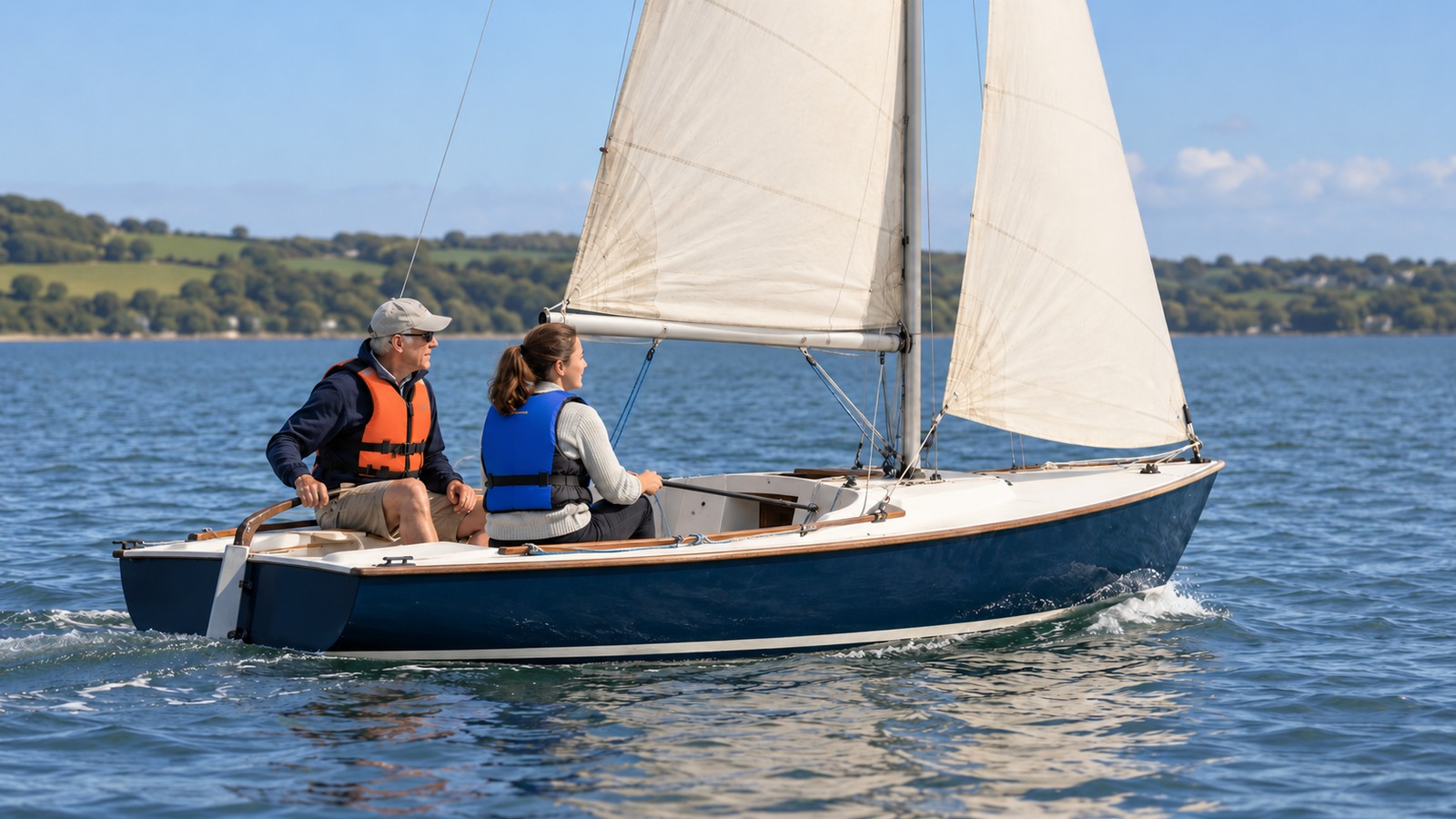
Your First Sail Is a Lesson in Connecting Wind and Motion
Learning to sail begins with a few understandable relationships: where the wind comes from, where the boat can travel relative to it, how the sails are adjusted, and how the helm changes direction. You do not need to memorize an entire nautical vocabulary before experiencing those connections. You do need a suitable boat, manageable conditions, properly fitted safety equipment, and a competent instructor who can take control while you learn. This guide follows a first supervised outing on a small training sailboat, with special attention to the decisions that make each task easier. Boat designs differ, so use it to understand the lesson rather than as a substitute for instruction aboard the vessel you will actually sail.
A: Learn the terms needed for the lesson as you use them.
A: It must use an achievable angle and often tack upwind.
A: Boat motion changes the apparent wind aboard.
A: The initial bow turn is generally opposite the tiller movement.
A: Trim must suit the course, sail, and conditions.
A: It provides room to observe and correct developing errors.
A: It changes the wind side through the stern and needs distinct preparation.
A: Tell the instructor and follow a coordinated recovery.
A: Further training and vessel familiarization are needed.
A: Choose a specific skill that needs supported practice.
Choose a Learning Setting That Leaves Room for Mistakes
A sheltered sailing school or club can provide a boat and conditions suited to a first lesson. Ask whether the course uses dinghies or keelboats, how many students share the boat, and what clothing and equipment are supplied. Dinghies respond quickly and may include capsize training; keelboats bring their own systems and handling considerations. Neither choice removes the need for instruction. The useful match is a boat and teaching arrangement that suit your mobility, confidence, and learning goals.
Before departure, tell the instructor about relevant concerns such as limited movement, poor swimming confidence, or seasickness. Wear the required correctly fitted lifejacket or buoyancy aid appropriate to the activity and location. Choose footwear with secure grip and clothing suitable for weather and water temperature. Keep loose straps and belongings away from moving gear. Comfort supports attention, and attention is easier to maintain when you know where you can sit, hold on, and move safely.
Learn the Few Words That Guide the First Lesson
The bow is the front, the stern the back, port the left side, and starboard the right side when facing forward. Windward is the side toward the wind; leeward is away from it. These words give the crew a shared way to describe movement even when people face different directions. Learn them through the actual boat rather than as an isolated list. Point to the relevant side or fitting as the instructor explains it.
A halyard raises a sail, while a sheet adjusts a sail’s position. The mainsail is usually attached to the mast and boom; a headsail sits ahead of the mast on many training boats. The helm may be a tiller or wheel. Your first job is to identify the controls you will use and those you should leave alone. Ropes that look similar can perform very different functions, so ask before releasing an unfamiliar line.
The boom deserves particular awareness because it can cross the cockpit when the boat changes its relationship to the wind. Learn the safe seating and movement positions for the vessel. Keep your head and body outside its path and listen for maneuver commands. Never assume that a quiet moment means the boom cannot move. Establishing that habit early makes the rest of the lesson less distracting.
Find the Wind Before Choosing a Direction
Observe flags, water texture, and any wind indicator fitted to the boat. Your instructor will help distinguish the wind you feel aboard from the wind over the water. The boat’s motion changes the apparent wind felt by the crew and sails. For an introductory lesson, the immediate aim is recognizing which side the wind comes across and how that changes when you steer. Keep looking outside rather than watching only an instrument.
A conventional sailboat cannot sail directly into the wind. It can sail at an angle toward it, across it, or away from it within the capabilities of its design and conditions. These relationships are called points of sail. The RYA explanation of points of sail provides a useful visual introduction. On the water, an instructor can help you connect the names with the feel of the boat and the position of the sails.
Steer Gently and Look Where the Boat Is Going
With a tiller, moving the handle to one side initially turns the bow toward the other side; a wheel usually turns the boat in the direction it is turned. Learn the actual arrangement before trying it. Small deliberate movements are generally easier to understand than large repeated corrections. Choose a distant reference for the intended direction and notice how the boat responds. Return the helm toward a steady position as the turn develops rather than continuing to add movement without watching the result.
The boat needs useful water flow over its steering surfaces to respond effectively. If it slows significantly, steering can feel weak or delayed. Tell the instructor what you feel instead of forcing the control farther. Sailing involves keeping enough coordinated motion for the task, not simply pointing the bow toward a destination. An instructor can restore a suitable course and explain which combination of steering and sail adjustment helps the boat recover.
Lookout remains part of steering from the first lesson. Scan the water ahead, nearby traffic, and the space the boat will enter during a turn. Sails can hide another vessel, so learn how the crew checks the obscured area. The instructor should explain who is maintaining overall control and collision awareness while you practice. Learning a new skill does not make surrounding traffic stop requiring attention.
Use short turns to learn the difference between steering toward the wind and away from it. Watch how the sail begins to luff when the course becomes too close to the wind, and how loading changes when the course changes. Avoid trying to solve every change alone. The instructor can separate the effects so you develop an accurate connection between an input and the response.
Adjust the Sail for the Course You Are Sailing
Sail trim means setting the sail to work with the apparent wind for the chosen course. On a simple training boat, a first exercise may involve easing a sheet until the sail begins to luff, then bringing it in enough to draw smoothly, under instruction. The exact method and limits depend on the sail and rig. Watch the sail shape and feel the boat’s response. Pulling a sheet harder is not automatically a way to sail faster.
Keep hands and clothing clear of blocks, cleats, and tightening loops. Never wrap a loaded sheet around your hand, and follow the instructor’s procedure for handling and releasing it. On boats with winches, learn the correct technique before putting a hand near a loaded turn. The practical skill includes managing the rope safely as well as choosing a sail setting. A smooth sail shape is not a successful result if the crew is exposed to an avoidable injury.
Change Tack as a Coordinated Crew Maneuver
Tacking turns the bow through the wind so the wind comes across the other side. The crew prepares, checks that the new course is clear, turns the boat, and handles the sails according to the vessel’s setup. Your first tack should be taught as a coordinated maneuver with clear commands. Ask what your own task will be and where you should move. Avoid standing or changing sides unexpectedly while the boat is turning.
Timing improves with practice. Turning too abruptly can lose useful speed, while handling a headsail too early or too late can complicate the maneuver. The instructor can manage those variables while you concentrate on one task. After completing the turn, settle on a sensible course and restore appropriate sail trim. A tack is complete when the boat and crew are organized on the new side, not merely when the bow crosses the wind.
Gybing changes the side of the wind by turning the stern through it, and the boom can move forcefully. Learn it through a separate, carefully supervised exercise with the correct preparation and crew positions. Do not improvise a gybe because it appears to be the shorter way around. Understanding that tacks and gybes have different demands is an important early lesson in planning turns.
Learn How This Boat Slows and Stops
Before you take greater responsibility at the helm, learn the instructor’s stopping procedure for the boat and conditions. A sailboat has no universal brake control. Slowing may involve changing course and reducing sail drive, while safe stopping near a dock requires additional planning and often auxiliary power on a keelboat. Ask how the boat will be controlled if the exercise does not go as intended. Practice the basic response in clear water before approaching obstacles.
A useful first lesson includes recovering from a slow or confused moment under guidance. You might notice the sail flapping, the boat losing steerage, or your intended direction becoming unclear. Describe those observations and let the instructor organize the recovery. This teaches you to recognize a developing problem early. Trying random helm and sheet movements can make the original cause harder to understand.
Return procedures depend on the boat, landing place, wind, and available assistance. Students should know whether sails will be lowered, when the engine may be used, and which crew duties remain. Keep lines clear of the water and stay within assigned roles. The arrival is still part of the sailing lesson, even when the destination feels familiar.
Once secure, help stow equipment according to the school’s routine and discuss the session. Name one relationship that became clearer, such as easing the sheet after bearing away, and one skill to revisit. Specific observations make the next lesson easier to build. A useful first outing ends with better understanding and a clear next step, rather than a claim that every sailing condition has been mastered.
Connect Wind, Heading, and Trim on a First Reach
Before beginning, agree on a clear request for the instructor to pause or take over. Then, in the instructor’s chosen open-water setting, use one short reach to connect the earlier skills. Identify where the wind comes from, choose a distant steering reference, and keep a steady course while observing the sail. On a beam reach, the wind comes from the side; the RYA points-of-sail guide explains that relationship. Ask the instructor to demonstrate the appropriate sheet adjustment, then observe the result without changing heading at the same time. Notice whether the sail fills, how the boat settles, and how much helm correction is needed. End the short exercise at the agreed place and explain what changed. If the explanation is unclear or the workload becomes uncomfortable, pause while the instructor controls the boat.
Build Confidence Through Repeated, Supported Practice
Arrange further instruction before extending your range or sailing independently. Practice steering, trimming, tacking, stopping, and lookout until you can combine them without losing track of the wider situation. Learn local navigation rules, weather assessment, capsize or recovery procedures appropriate to the vessel, and how to request help. These skills develop alongside the enjoyable feeling of the boat moving under sail.
Keep early outings short enough to remain attentive and choose conditions that match demonstrated ability. Different boats and stronger winds can change the workload substantially. Carry your questions into the next session and ask for exercises that address them. Sailing becomes more rewarding as the moving parts connect: wind direction informs the course, the course informs trim, and clear communication keeps the crew working together.