Safe Anchoring Starts With Knowing When to Choose Another Spot
A suitable anchoring depth is one your rode, anchor, recovery equipment, and available swinging room can support. The rode aboard is finite, the seabed may not accept the anchor, and a deep or exposed location can leave too little room for a reliable hold. The useful skill is deciding whether your equipment and the available anchorage fit each other. Depth affects how much rode you need, how far the boat may swing, how you retrieve the anchor, and how much margin remains when the tide rises or weather deteriorates. Start with sheltered conditions and equipment matched to your vessel. Then assess the bottom, calculate the vertical distance correctly, deploy the anchor under control, and verify the result. A location that fails those checks is a reason to move rather than shorten the rode and hope.
A: Reaching bottom does not establish enough scope, suitable holding, or safe recovery.
A: Yes. Measure the vertical distance to the rode's departure point above the water.
A: Rising water increases the vertical distance and reduces scope if the rode length stays unchanged.
A: Additional chain cannot guarantee that an unsuitable anchor will grip rock reliably.
A: Select another position when adequate holding and swinging room cannot coexist.
A: Use the proper bow arrangement; stern anchoring can expose a small boat to swamping.
A: It may show ordinary swinging or dragging, so compare its pattern with the anchor position and fixed references.
A: Use the load-bearing arrangement specified for your system rather than assuming the windlass is the mooring point.
A: Weather, chafe, neighboring vessels, and device limitations still require observation.
A: Continue to another lawful anchorage or berth within the capabilities of the boat and crew.
Read the Anchorage Before Reading the Depth Sounder
Study a current chart and local anchoring restrictions before selecting a spot. Look for a sheltered area outside navigation channels, cable corridors, protected habitats, and other prohibited zones. The shape of the shoreline matters because shelter from today’s breeze may become exposure after a wind shift. Identify a route out that remains usable after dark or at low water. Nearby boats provide clues about an anchorage’s popularity, but their presence does not establish legal access, adequate depth, or dependable holding for your vessel.
Consider the full expected stay rather than the moment you arrive. Check the forecast, tide range where applicable, local current changes, and likely wakes. A comfortable lunch stop may be unsuitable for an overnight stay if a front will remove the shelter. Know your boat’s draft and add a sensible clearance margin for waves, uncertain soundings, and bottom irregularities. If the chart, observations, and depth display disagree, investigate before lowering the anchor.
Match the Anchor and Rode to the Bottom
Anchors develop holding power through their interaction with the seabed. Sand and suitable mud may allow a well-matched anchor to bury, while rock, thick weed, debris, or very hard ground can prevent dependable engagement. Different anchor designs have different strengths and limitations. Follow the manufacturer’s sizing and deployment guidance for the vessel, displacement, windage, and expected loads. A large cabin can create substantial wind load even on a relatively short boat. Carrying an anchor that fits neatly in the locker does not prove it is adequate for the conditions. Local knowledge can help identify holding grounds, but it cannot turn unsuitable equipment into a reliable system.
Measure From the Seabed to the Bow Roller
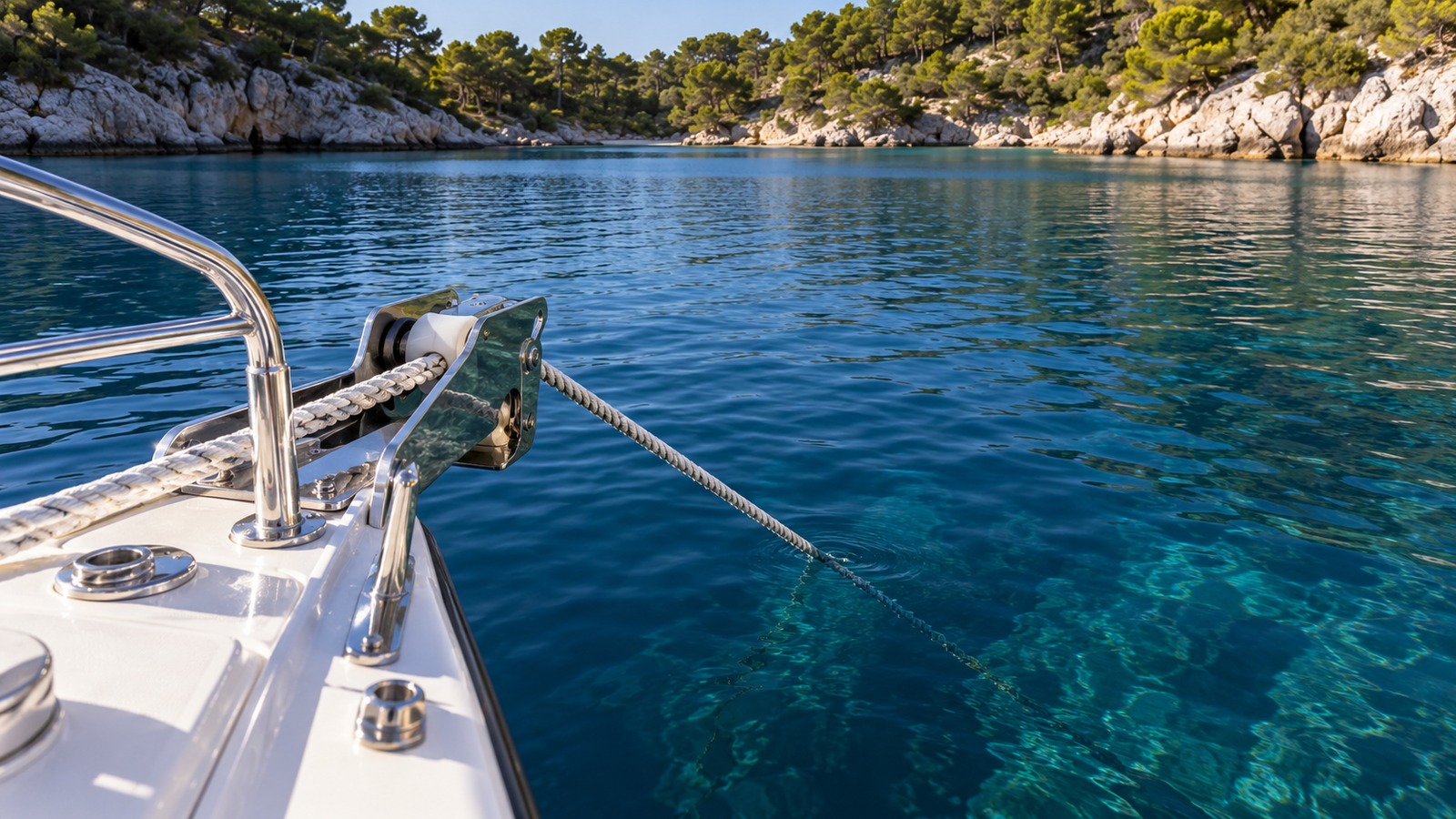
Scope is the ratio of deployed rode length to the vertical distance between the seabed and the point where the rode leaves the bow. That distance includes water depth and the height of the bow roller or chock above the surface. It should also account for the highest water level expected while anchored. Reading twelve feet on a sounder and multiplying by a chosen ratio can understate the required length if the bow adds another four feet. Confirm what the sounder actually displays: depth beneath the transducer, beneath the keel, or an offset water-depth estimate.
For an illustrative calculation, assume the water will be fifteen feet deep at the highest expected tide and the bow roller is four feet above the water. The relevant vertical distance is nineteen feet. At a planned scope of seven to one, the deployed rode would be 133 feet. This is an arithmetic example rather than a universal recommendation for every anchor system. Conditions, rode composition, anchor design, and manufacturer guidance determine appropriate scope. The BoatUS Foundation anchoring guide explains the role of scope and the need to evaluate the complete anchoring arrangement.
Mark the rode in a system you can read and maintain. Unmarked rope and hurried guesses make a careful calculation largely useless. Before departure, explain those markings to the person who will handle the rode. A second crew member who can recognize the planned length provides a useful cross-check during a busy anchoring sequence. Check the actual length aboard, the condition of the chain and rope, and whether their connection can pass through the equipment safely. Secure the bitter end to an appropriate strong point so the entire rode cannot disappear overboard. Keep the marking record aboard where another crew member can find it.
Check the Whole Swinging Area
An anchored boat does not remain directly above its anchor. Wind and current move it around the attachment point, and a reversal can place it on the opposite side of the position where it first settled. Evaluate the deployed rode, vessel length, local depth, and the way your boat swings when deciding how much room is needed. Avoid treating the rode length as an exact horizontal radius because the geometry changes with depth and loading. Give neighboring boats, shoals, rocks, and shoreline hazards generous clearance. A short stay still needs room for an unexpected gust or passing wake.
Neighboring vessels may respond differently to the same conditions. A deep-keel sailboat can follow current while a shallow, high-sided powerboat responds more strongly to wind. Boats using different rode lengths may also move through different arcs. Arriving close to a vessel that has already anchored can create a problem when either boat swings. If you cannot establish adequate separation without reducing your planned scope, select another position. Crowding is a location problem rather than a reason to compromise the holding arrangement.
Lower the Anchor While the Boat Moves Back Gently
Prepare the crew, communication, and equipment before reaching the drop position. Wear suitable flotation, keep feet away from coils, and keep fingers clear of the bow roller, windlass, and chain. Position the boat so it can settle back from the anchor as rode is paid out. Lower the anchor under control rather than throwing it and a pile of rope over the side. Let the boat move back gradually, using propulsion only as appropriate to the vessel and conditions. Avoid depositing all the rode on top of the anchor, where it may foul before the anchor engages. Confirm that the rode leads from a proper bow attachment arrangement. Anchoring a small recreational boat from the stern can expose it to swamping forces and is unsafe as a general anchoring method.
Set the Anchor and Prove That It Holds
Once the planned length is deployed, allow the rode to straighten and the anchor to engage. Apply a controlled holding check suited to the boat and anchor system, following the equipment guidance and any instruction you have received. Watch the vessel’s position against fixed references while increasing load gradually. Sudden aggressive power can create unnecessary shock or conceal a poor deployment. The goal is to see that the boat settles in a stable position and the anchor supports the expected load. A momentary pause in movement is not proof that a fluke has buried securely.
Use more than one method to assess position. Two well-chosen shore references can reveal movement, while the chartplotter track helps show whether the boat is swinging around a stable point or moving bodily away. Depth changes may also reveal an unwanted trend. Configure an anchor alarm around the actual anchor location and a realistic movement allowance rather than assuming the boat’s position when you press the button is the anchor’s position. Confirm the device’s method, GPS limitations, power supply, and audible alert. An alarm supplements observation rather than replacing it.
If the anchor drags during the check, retrieve and reset it or choose a different bottom. Adding a little more rode may help when insufficient scope was the actual cause, but it will not solve every problem. Fouling, weed, a poorly matched anchor, or inadequate seabed penetration may require a different approach. Make the decision while there is still room to maneuver. Do not wait until the boat reaches another vessel before treating movement as significant.
Understand What Changes in Shallow Water
Shallow anchorages can appear reassuring because less rode is needed, yet the margin beneath the keel may shrink quickly as water falls. Consider the full tide cycle, local drawdown, wave troughs, and the possibility of moving toward a shoal as the boat swings. The shallowest point inside the swinging area matters more than the single reading at the drop position. A soft-looking bottom does not make grounding harmless, especially around cooling-water intakes, propellers, and rudders. Keep the same disciplined holding check you would use in deeper water. If sufficient scope and safe under-keel clearance cannot coexist at that location, move to a more suitable part of the anchorage.
Deep Water Demands More Than Extra Rope
As depth increases, the amount of rode required can exceed locker capacity surprisingly quickly. For example, forty feet of water plus five feet of bow height creates a vertical distance of forty-five feet. A seven-to-one planning ratio would require 315 feet of rode before allowing any additional working reserve. A boat carrying 200 feet cannot satisfy that plan simply because the anchor reaches the seabed. Reduce the ambition of the anchorage rather than pretending that reaching bottom equals secure anchoring.
Recovery loads also increase as more chain and anchor weight hang vertically below the bow. Check the windlass rating, electrical supply, duty cycle, and the vessel’s approved anchoring arrangements. A windlass is normally used to retrieve the system, with anchoring loads transferred through suitable equipment according to its design. It should not be assumed capable of pulling the entire vessel forward against strong wind or freeing a deeply fouled anchor. If the system cannot be recovered safely by the available crew and equipment, that depth is outside the practical plan.
Keep Watching After the Engine Stops
Make an initial inspection once the boat has settled, then reassess whenever wind, current, tide, or nearby traffic changes materially. Check the rode lead, chafe protection, deck hardware, and the clearance to other boats. Verify that an alarm can be heard from the sleeping area if staying overnight. Keep a practical way to start the engine and leave, including clear access to controls and a crew who know their roles. A secure afternoon set does not eliminate the need for an evening weather update. If conditions move beyond the equipment or crew’s limits, relocate early while visibility and sea room still favor a controlled departure.
Retrieve Without Turning the Bow Into a Worksite Hazard
Prepare the route out and communicate before recovery begins. Bring the boat toward the anchor in a controlled way while recovering slack, rather than using the windlass to tow the boat through the water. Keep the rode away from the propeller and avoid standing inside rope loops. As the anchor approaches the bow, reduce speed and prevent it from swinging into the hull. Secure it properly for travel before accelerating. A fouled anchor may need a specialist recovery plan, and risking a crew member or damaging a loaded fitting is not a sensible response.
Afterward, inspect the system for chafe, distorted hardware, and debris that could affect the next deployment. Record what bottom, depth, scope, and conditions produced a dependable hold. That experience helps you choose future anchorages within the limits of your actual boat. Competent anchoring is a repeatable process of selection, calculation, deployment, verification, and observation. It always includes the option to leave.